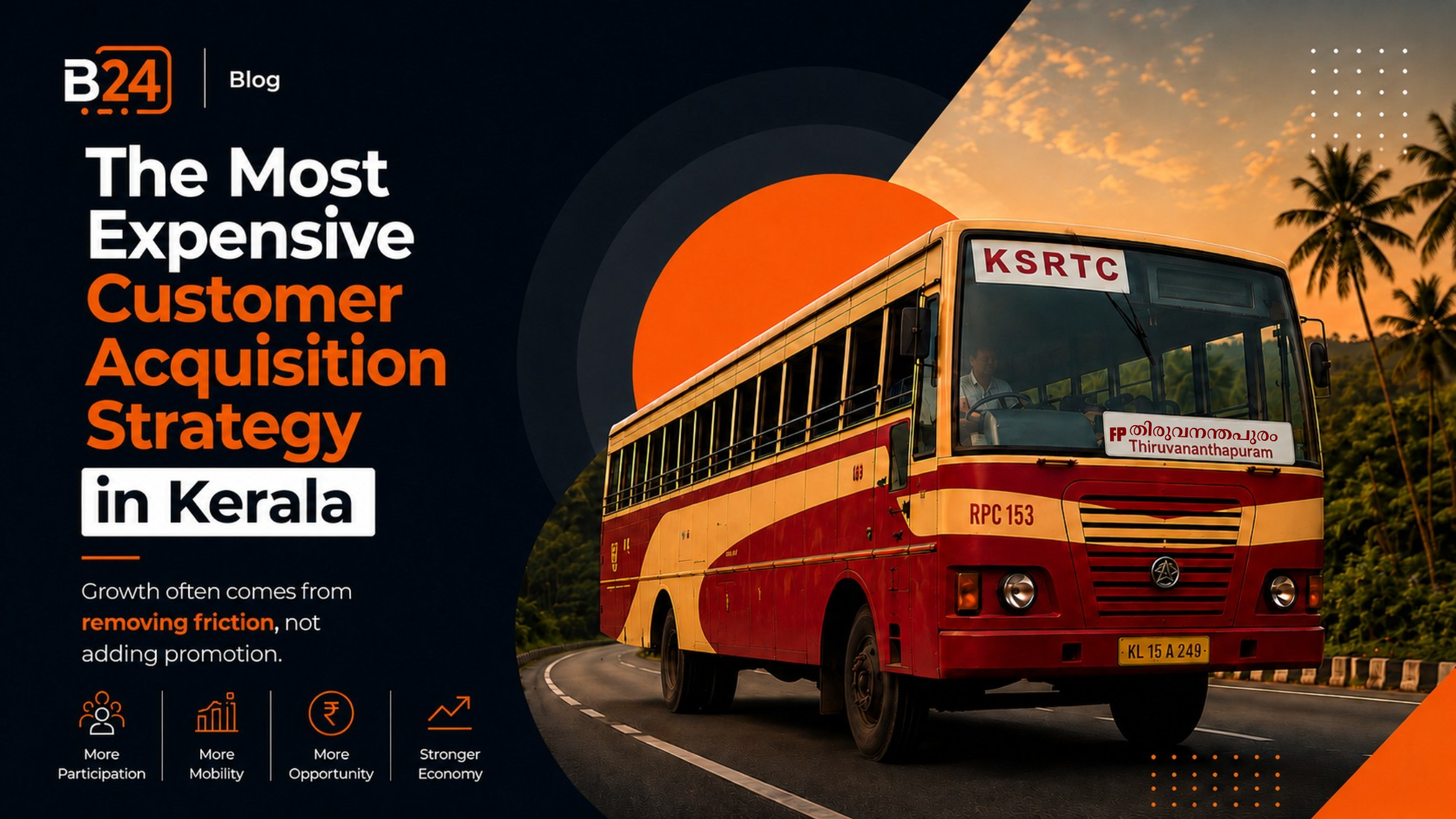
The Most Expensive Customer Acquisition Strategy in Kerala
Marketing · Wed Jun 10 2026 · Jafin Jahfar
When Kerala announced free bus travel for women, most discussions immediately focused on politics, public spending, and implementation.
But while reading about the initiative, I found myself looking at it through a completely different lens.
Not as a policy.
As a growth strategy.
Because if you strip away the politics, what is actually happening?
An organization is choosing to absorb a significant cost in order to encourage more participation.
That idea isn't unique to governments.
Businesses do it all the time.
The Most Common Growth Mistake
When companies want growth, the first instinct is usually:
- Run more ads
- Increase marketing spend
- Create more content
- Launch more campaigns
In other words, they try to increase attention.
But attention isn't always the bottleneck.
Sometimes participation is.
And participation is often limited by friction.
Growth Through Friction Removal
Think about some of the most successful growth strategies in modern business.
Netflix offered free trials.
Amazon introduced Prime shipping.
Food delivery apps offer discounts for first-time users.
SaaS companies launch freemium plans.
Open-source software companies give away their core products for free.
At first glance, these decisions look expensive.
And they are.
But the objective isn't revenue today.
The objective is reducing the barrier to entry.
Because every product has friction.
Sometimes it's money.
Sometimes it's effort.
Sometimes it's uncertainty.
The businesses that grow fastest are often the ones that identify the biggest friction point and eliminate it.
What KSRTC Is Actually Doing
Viewed through this lens, the free travel initiative becomes interesting.
The scheme isn't promoting transportation.
It's reducing the cost of participation.
For many people, transportation is a prerequisite for:
- Work
- Education
- Healthcare
- Shopping
- Social mobility
The initiative removes one obstacle that might prevent someone from participating more actively in daily life.
Whether the economics work long-term is a separate discussion.
The principle itself is what matters.
Growth can come from removing barriers.
The Same Lesson Applies to Businesses
Many businesses assume growth requires adding something.
More features.
More campaigns.
More channels.
More complexity.
But sometimes the highest-impact decision is removing something instead.
A complicated onboarding process.
A long sign-up form.
An unnecessary approval step.
A confusing pricing structure.
A hidden fee.
A delayed response.
Every friction point creates drop-off.
Every friction point reduces participation.
Every friction point quietly slows growth.
The Cost of Inaction
One of the most interesting things about growth investments is that their value is often invisible.
Costs are obvious.
Lost opportunities are not.
It's easy to measure how much something costs.
It's much harder to measure:
- Customers who never signed up
- Users who abandoned onboarding
- Prospects who never replied
- People who never participated
As a result, organizations often optimize for cost reduction instead of participation growth.
And sometimes that becomes more expensive in the long run.
A Better Question
Whenever growth slows, many organizations ask:
"How do we attract more people?"
A more useful question might be:
"What is stopping people from participating today?"
The answer isn't always another marketing campaign.
Sometimes it's a barrier hiding in plain sight.
And removing that barrier can create more growth than any advertisement ever could.
That's what makes Kerala's free bus travel initiative interesting.
Not because it's transportation.
Not because it's politics.
But because it highlights a principle every founder, marketer, and business owner eventually discovers:
Growth often comes from removing friction, not adding promotion.