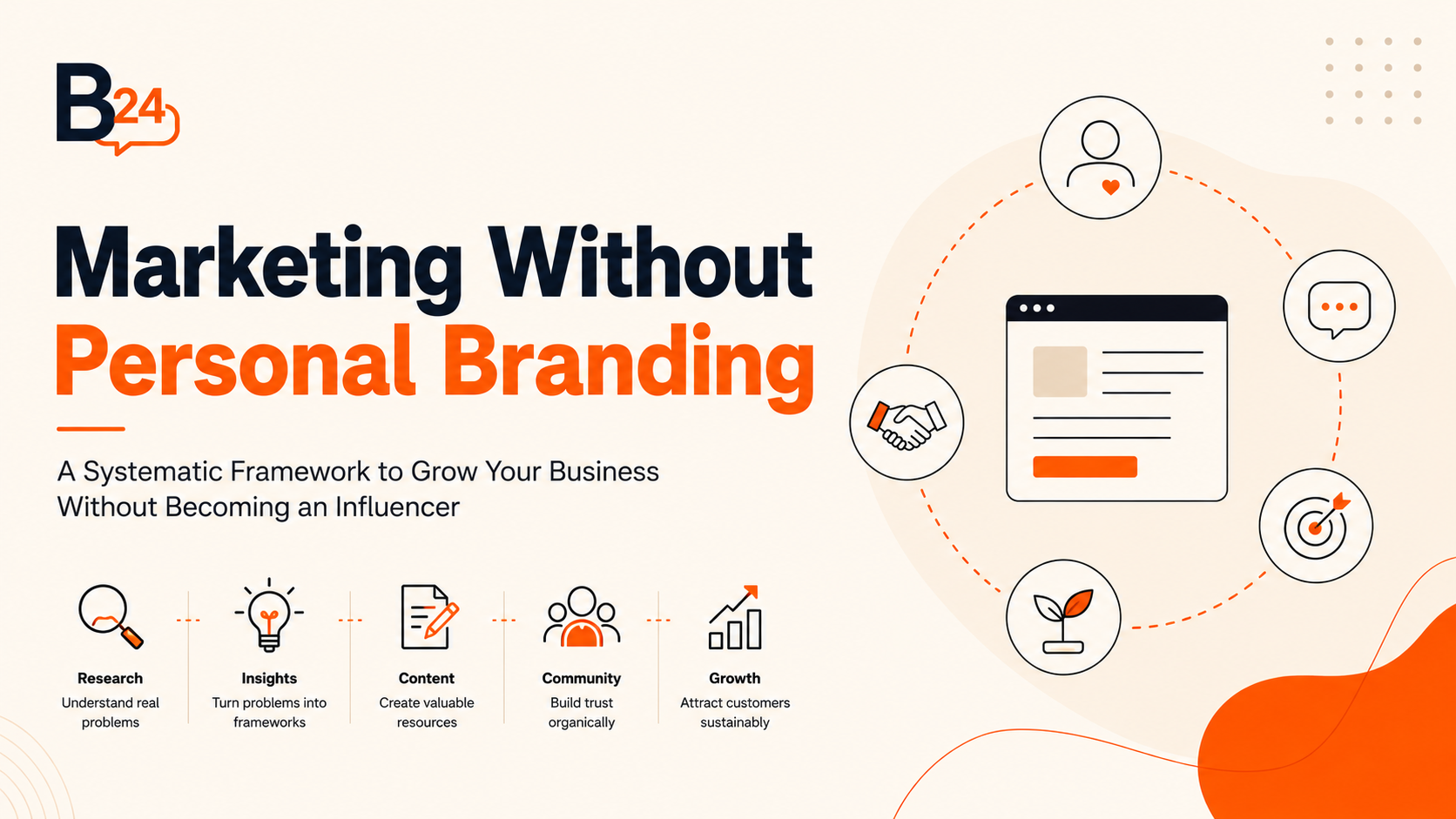
Marketing Without Personal Branding: A Systematic Growth Framework for Introverts
Sales Process · Tue Jun 09 2026 · Jafin Jahfar
Most business owners think marketing requires becoming an influencer.
Post every day. Share your life online. Record videos. Build a personal brand. Reply to comments. Become the face of the company.
For many founders, that sounds exhausting.
Especially if you're an engineer, operator, consultant, or business owner who values privacy.
The good news?
You don't need a personal brand to build a successful business.
You need trust.
And trust can be engineered.
Why Traditional Marketing Feels Uncomfortable
Many founders approach marketing with the same mindset they use for sales:
"How do I get more customers?"
The problem is that modern buyers rarely purchase from businesses they don't trust.
Before someone buys, they want answers:
- Do you understand my problem?
- Have you solved this before?
- Can I trust your advice?
- Are you genuinely helpful?
Most businesses try to answer these questions after asking for the sale.
The best businesses answer them long before.
Marketing Is Not Art. It's a System.
Engineers often struggle with marketing because it appears random.
One person posts a video and goes viral. Another spends months creating content and gets nothing.
From the outside, marketing looks chaotic.
But underneath, marketing is simply a system:
Problem → Trust → Attention → Conversation → Customer
Most businesses skip the first two steps.
They focus entirely on attention.
The result?
Lots of activity. Very little trust.
The Trust-First Framework
Instead of asking:
"How do I get customers?"
Ask:
"How do I become the most helpful person discussing my customer's problem?"
This single shift changes everything.
Trust-first marketing follows four stages:
Stage 1: Research
Find out how customers describe their problems.
Look at:
- Quora
- Facebook Groups
- Industry forums
- Product reviews
Document recurring frustrations.
Not your assumptions.
Their actual words.
For example:
A business owner rarely says:
"I need CRM automation."
They say:
- "Leads keep slipping through the cracks."
- "Nobody follows up."
- "We lose customers after the first conversation."
- "My team forgets to reply."
Those are marketing gold.
Stage 2: Insights
Once patterns emerge, turn them into observations.
Example:
Most businesses don't have a lead generation problem.
They have a follow-up problem.
This becomes a framework.
Frameworks become content.
Content becomes authority.
Stage 3: Content
You don't need to show your face.
You don't even need videos.
Start with:
- Blog posts
- Carousels
- Community discussions
- Case studies
- Anonymous company accounts
The goal isn't virality.
The goal is usefulness.
A single helpful article can generate traffic for years.
A viral post might disappear tomorrow.
Stage 4: Product
Only after establishing authority should you introduce solutions.
People buy from businesses they already trust.
That's why the most effective marketing often doesn't feel like marketing.
It feels like education.
The Faceless Growth Channels That Actually Work
If you prefer privacy, focus on channels where expertise matters more than personality.
SEO
Search traffic compounds over time.
Someone searching:
"How do I stop losing leads?"
already has a problem.
Your job is to provide the answer.
Reddit is one of the largest repositories of real customer pain points.
Don't promote.
Participate.
Explain.
Teach.
The trust you build compounds.
Quora
People openly describe the problems they want solved.
Answer questions thoroughly.
Many answers continue generating traffic years later.
Industry Communities
Niche Facebook groups, Slack communities, WhatsApp groups, and forums often outperform large social platforms because trust develops faster.
Email Newsletters
Newsletters remain one of the few channels you fully own.
No algorithm. No platform dependency.
Just direct access to an audience.
The First 100 Customers Are Usually Earned, Not Bought
Many founders think they need ads.
Most don't.
The first milestone isn't scale.
It's learning.
The first 100 subscribers, users, or customers teach you:
- What people care about
- What language resonates
- What objections appear repeatedly
- What problems are most painful
Every conversation becomes research.
Every question becomes content.
Every content piece becomes an asset.
The Engineering View of Marketing
If you're technical, stop viewing marketing as creativity.
Think of it as system design.
Inputs:
- Customer problems
- Market research
- Community conversations
Processing:
- Insights
- Frameworks
- Content
Outputs:
- Trust
- Authority
- Conversations
- Customers
Marketing isn't magic.
It's simply a process of consistently reducing uncertainty for potential buyers.
And the businesses that earn trust first usually win.
Final Thoughts
You don't need to become an influencer.
You don't need to post selfies.
You don't need to share your entire life online.
You only need to understand a problem deeply enough that people trust your perspective.
Authority is built through usefulness.
Trust is built through consistency.
Sales are a byproduct of both.
The businesses that focus on helping first rarely need to convince people to buy later.